from Marquette Monthly December, 2010
A secret of the living dance
“I go around pitying myself, but forget I am being carried across the sky by a Great Wind.”
—Ojibway saying
These are uncertain times. Jobs are hard to find, local merchants are struggling to make ends meet as we approach the end of another calendar year. With rising unemployment, the haunting specter of a continuing economic recession hangs like a winter’s cold, dark sky over our Northern Michigan communities.
Paradoxically, this also is a season of gift-giving, family gatherings, feasts and lights, hymns and carols, rituals of prayers and thanksgiving. For those of us involved in churches and synagogues, it’s a time we inevitably witness astonishing acts of benevolence. How do we fit these opposing realities together?
One approach is to take a moment and ponder a fundamental question: Is there a bounty of gift and abundance at the heart of the universe? Or, do we choose, as my good friend and neighbor Bishop James Kelsey would have said, to see our lives, as a “zero sum game,” a world of scarcity where there’s only so much to go around, a world where those who live in “Rich-ist-tan” finally win and everyone else, by their standards, loses.
One’s point of view on this thorny question is, of course, a personal judgment call. But even against most dire predictions, let me dare suggest those who live in the Upper Peninsula, isolated and cut off from more prestigious bustling cities and centers of commerce, are, despite fierce winters and bug-infested summers, surrounded by nothing less than a magical, enchanted and sacred landscape.
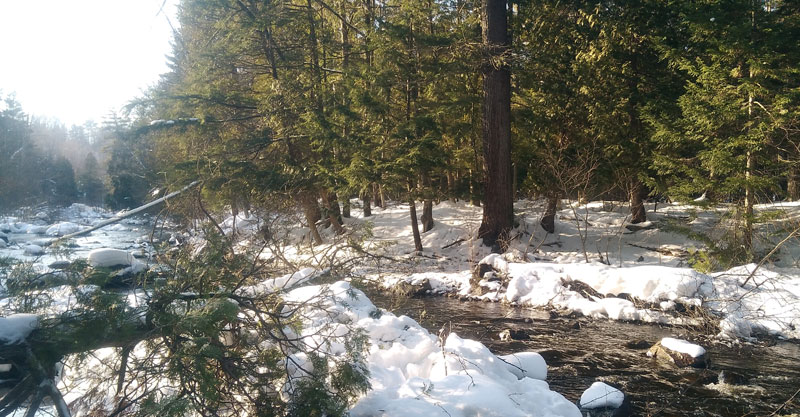
In recent years, I’ve worked in collaborative partnerships with at-risk youth on summer environmental projects planting trees on the banks of rivers and streams, helped guide clergy and priests on kayak trips along the Lake Superior shoreline, worked with Native American communities restoring native plants and facilitated trainings for hospice workers, trudging along snow-covered trails on snowshoes and skis. During these experiences the forests and skies, the rocks, lakes and streams have whispered a kind of language that, only now, I am beginning to understand. Here are some lessons.
A Secret of the Living Dance
This fall I invited Kenn Pitawanakwat, a member of Northern Michigan University’s faculty whose home is Ontario’s Wikwemikong Reserve on Manitoulin Island, to offer some insights about language and landscape to a university class I was teaching on the dynamics of religious experience and Native cultures. He reminded us that the local Native American Anishanabe language he teaches is roughly eighty percent verbs and twenty percent nouns, while the English language is eighty percent nouns and twenty percent verbs.
Class members smiled when he used the term spa-diiye’abwin for sitting on a chair, an Ojibway (Anishanabe) expression that literally means wrapping or seizing your rear end around something. With a twinkling smile, Kenn informed us that everything is alive and dancing in the human language that first interpreted our landscape.
Living the seasons here, all of us in the Upper Peninsula are reminded again and again of the ongoing cycle of life. Nothing remains solid and immoveable; everything is shifting, in transition. It’s a sensibility that lends itself to an understanding of this earth we call home as a living, breathing sphere moving in a universe that itself is expanding and contracting. Carl Jung, the renowned twentieth century Swiss psychiatrist, one of the great explorers of the inner world, often charmingly echoed this conviction: “Even rocks are alive,” he would say. “The only difference is that they breathe slower than the rest of us.”
Engaging the natural world as a living, breathing dance reclaims a fresh reverence and sensitivity for everything around us. This summer the Cedar Tree Institute, with support of Jan Schultz, part-time resident of Marquette and botanist for the Eastern Region of the United States Forest Service, helped initiate a native plants restoration project with the Keweenaw Bay Indian Community. We invited experts in the field for a September training session on the KBIC Reservation.
Guests included Scott Heron, a thirty-seven year-old ethnobotanist of Odawa and French Canadian descent. Scott remarked one morning to a group of us gathered at the tribe’s newly erected greenhouse that when his grandmother goes into the forest to harvest plants and herbs (called “medicines” among indigenous peoples), she softly sings traditional prayer songs. In her left hand, closest to her heart, she carries, as she walks, a small palm-full of tobacco, scattering the asema gently upon the forest floor as an offering of thanks.
The challenge collectively to recover and embrace a new land ethic, one in which we see the natural world around us as a tapestry, a bountiful, though at times severe teacher, a living, breathing “Mother” is a critical, timely one. A failure to do so has consequences that only recently have we begun to appreciate.
A Hidden Tapestry
My first introduction to the interconnectedness of the Great Lakes Basin to the rest of North America took place in an airport in Thunder Bay, Ontario. I was on my way home from a Lake Superior Binational Forum meeting and, waiting to board a plane, struck up a conversation with an environmental scientist from the University of Minnesota. He remarked that after years of trying to trace the origin of dioxin (a dangerous pollutant) that is increasingly threatening the Lake Superior fishery, they had finally solved the riddle.
“Atmospheric loading is the technical term,” he said. “ It refers to toxins and poisons that come from rain, carried by winds sometimes hundreds and thousands of miles from a source.
Through mapping and satellite monitoring, we’ve traced this particular pollutant of Lake Superior to its origin at one factory—in St. Louis, Missouri.”
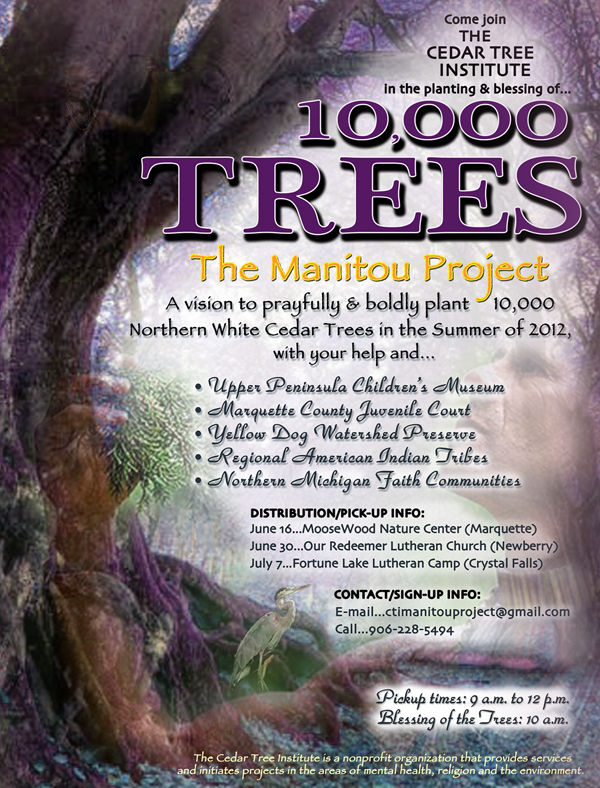
Most of us who live in the Upper Peninsula like to think we can ignore such a fragile, mysterious fabric connecting the natural world. Such attitudes are illusion. During one recent season of tree planting, it was an unsettling revelation for me to learn that the distinctive Northern White Cedar, which in many ways rivals the more noble White Pine as Northern Michigan’s signature tree, is not being replanted by timber companies. According to their researched projections, those companies have concluded the Northern White Cedar won’t reproduce itself quickly enough for profitable harvest.
What most of us are not aware of, including, I suspect, commercial timber industry executives, is that Northern White Cedar grows along much of the Great Lakes shoreline, providing a kind of unique net that traps small insects. What we’re only now learning is that these groves or feeding lines mark specific migration paths for songbirds and other winged creatures. When the Cedar is gone, the birds will be gone. Who could imagine such connections even fifty years ago?
Another striking example of this inseparable web of life are the 220 major watersheds that surround Lake Superior. For years, many in the generations before us thought nothing about pouring oil, paint and other pollutants down storm sewers. We never made the connection that these contaminants would all flow inevitably down into the waters of the Lake Superior Basin.
Similar linkages can be found underlying current and disturbing fish advisory warnings for anglers and consumers. We thought that what we can’t see, we should not fear. Not long ago I asked two respected fish biologists, one from Houghton and one from Duluth, whether they had any concern about contamination by endocrine disrupters (chemicals that mimic estrogen) in Michigan fish.
I asked the biologists whether they limit their consumption. Both of them replied, “I don’t eat fish.” I was obviously curious about their response. They added they keep this a private matter because of political pressure. Spending professional time analyzing pollutants and toxins, they knew too much.
There’s no intention here to discourage supporting our local fisheries or restaurants, but it’s a reminder that there is a hidden, critical tapestry that connects the human health to the ecosystem in which we live. This still is not recognized by most of the public.
How many citizens are aware that since the 1990s, hundreds of millions of dollars continue to be invested in what the US Environmental Protection Agency has designated 20 Areas of Concern (AOCs) around Lake Superior? These catastrophic cleanup efforts to repair damaged ecosystems have been funded (or at least promised to be so) by both the Canadian and United States governments. They are an irrefutable acknowledgment, not only by our government but also by local communities who have demanded these cleanups, that the generations before us just didn’t get it. We are now paying the cost.
What we do personally and collectively matters about how we protect and live with our environment. This is a gift and lesson the earth is teaching us. Our smallest actions not only influence the health of those we love, but, as we are only now beginning to understand, will impact the quality of life for generations to come.
The Indifference of God
One evening last summer, huddled at a camp near Eagle’s Nest north of Marquette, a group of kayakers and I were discussing an essay written by Beldon Lane, a theologian and naturalist. Insightful and challenging, the writer reflects on his extensive hiking and camping experience in the hot, dry canyon country of America’s Southwest. Lane suggests that nature probably is the greatest teacher of humility—for the simple reason it does not play favorites.
Stewart Joseph, a local kayak guide and accomplished paddler, reminds tourists of this hard truth when he warns recreational boaters that “Lake Superior is unforgiving.” This summer we all learned that lesson with seven drownings in six weeks along fifty miles of Lake Superior shoreline. Severity of wind and weather along with lethal consequences of marginal judgments drew no distinctions between tourists and residents, young and old, sportsman and weekend swimmer.
But there are even more personal dimensions to nature’s gift that speak to the human condition. Deep down inside each of us, we quietly carry a wager we will beat our own mortality. If we think positively, eat well, exercise diligently, say our prayers, perhaps we can defy the odds. It is a fantasy perpetuated by many pharmaceuticals, medical professionals, health food aficionados, Jesus Camp folk and New Age preachers.
The indifference of nature (some may say “of God”) reminds us we are all visitors, just as the creatures of the forest and birds of the air are with us for only a few seasons. Larry Skendzel, medical director for one of our local hospices, echoed a Buddhist teaching on spirituality and health during a recent community presentation. It will be our personal worlds of meaning that ultimately shape our experience of both disease and health, not the length of our days.
Sooner or later all of us will suffer illness of both body and mind, he said. And one day we all return to dust.
Such a lesson from the earth is offensive, but necessary, spiritually speaking, to choose a life of gratitude and graceful intention. If we embrace such understanding, everything and everyone becomes a marvelous and temporary (even if troublesome) gift for a moment, a day, a year. Scot Stewart, a local birder and middle school teacher, gently nudges us with such awareness with his regular local newspaper columns on bird sightings and seasonal migrations.
Reading observations from him and other Audubon members is a sensitive, beautiful reminder there are forces of nature, mysterious cycles of season, that carry us along, regardless of our more myopic, personal agendas, ushering in visitations of the blue jay, the sparrow, the warbler and sandpiper.
One of the questions people of good will need to ask is who among us will protect these earth gifts? My experience suggests, disappointingly, it will rarely be government or civic leaders. Others, it seems, are called among us to this special kind of work. Their names are familiar to those who follow current controversies about how we are to live here with the landscape we call home. Some are gone, others remain with us: Fred Rydholm, Lon and Lynn Emerick, Jim Kelsey, Gail Griffith, Cynthia Pryor, Chauncey Moran, John Saari, John Rebers, Jan Zender, Rochelle Dale, Michelle Halley. They are the “priests” who have lived close to the land and have taken the risk, and sometimes public ridicule, to stand up and, while respecting those who differ, voice carefully crafted concerns for the health and future of our land and peoples.
In recent weeks, Lois Gibbs from the Center for Health and Environmental Justice visited our community. She was the closest thing to an Old Testament prophet I’ve heard after working, in numerous capacities, for twenty years with grass-roots community action groups in Seattle and Jerusalem, Chicago and San Salvador.
Gibbs was a twenty-three-year-old mother of two children at New York’s Love Canal in 1978 with no college degree. Still unpretentious, clear-eyed during her visit with us, she related her neighborhood’s successful struggle against one of this country’s most powerful petroleum companies to move families from a neighborhood that was built on a dump of 20,000 tons of toxic chemicals.
She came to speak to our university and interested community members, telling her story about what it takes to organize citizens to fight for a just and healthy world. Some decisions, she admitted, will not lead us to better economic times, but protecting clean air and water for our children can lead to a more humble, real experience of community, power, grace and goodness.
We live in a place of wonder and ecological magnificence. To honor the hidden mysteries of the earth’s landscape here will lead us into deeper places of gratitude. Remember, December is our community’s special gift-giving time.
Some of you may find, these weeks, a church or synagogue, others of you circles of friends. You don’t have to understand everything. You need only think of the power of this place where we live, the harshness of seasons, the beauty of the sparrow hawk and wary deer. To place your left hand next to your heart and whisper “Thank you.”
– Jon Magnuson
December 2010